


Welcome to the podcast Organized Money. You can listen to today’s episode on Apple on Spotify, or wherever you get your podcasts.
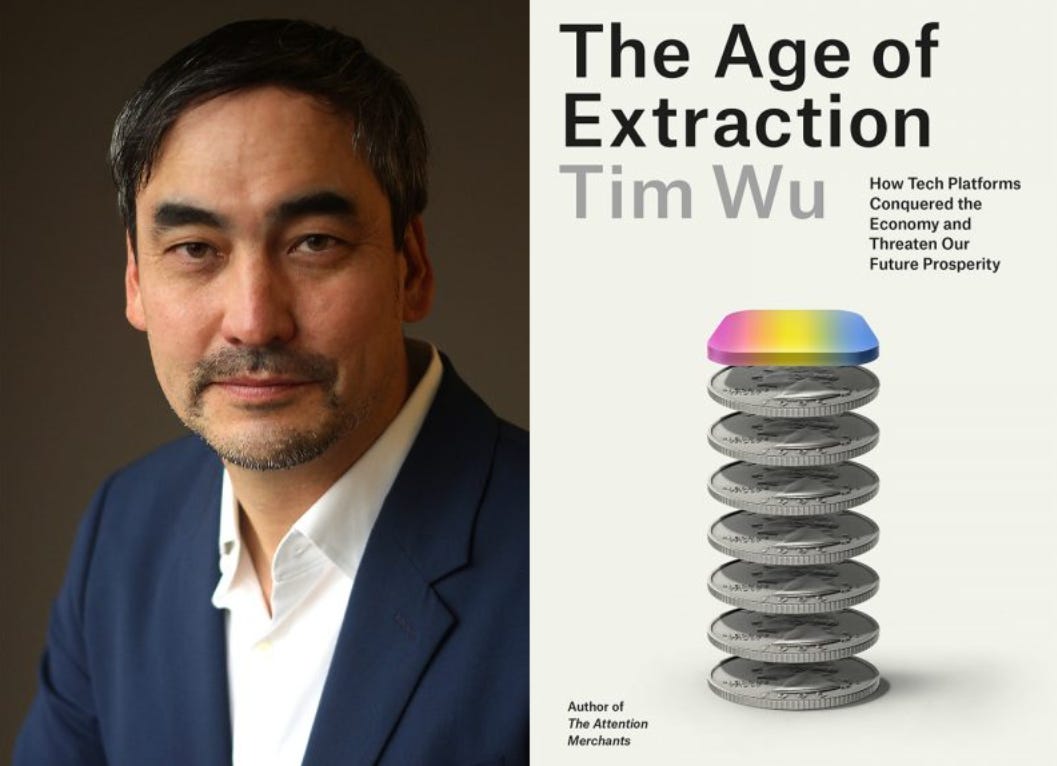
In this episode, David and Matt talk with Tim Wu, the man who coined “net neutrality,” about how tech platforms went from scrappy innovators to the defining power centers of the modern economy. Wu walks through the early idealism of the internet, the missed warnings about platform power, and the moment Silicon Valley embraced monopoly as a business model. Along the way, he connects the dots between Big Tech, rising inequality, and the political risks of letting a few companies control so much of modern life. Tim Wu writes about all of this in his new book, The Age of Extraction: How Tech Platforms Conquered the Economy and Threaten Our Future Prosperity.
Listen via Apple or Spotify, or wherever you get your podcasts.
Another thing we’re doing this year is providing transcripts and video for every episode. Check your inbox for that soon.
Thank you so much for listening. If there’s a monopoly you’d like us to explore this year, or if you have anything else to tell us, please let us know by leaving a comment or by responding directly to this email.
Re: chit-chat at the end of the segment...An anti-monopoly movement serving as a moral lever to separate the otherwise inclined from MAGA to help build a movement against American oligarchs--sounds good to me. A foundation already exists: the small, albeit important, and incremental fusion between Rs and Ds over strands of anti-monopoly legislation at all governmental levels. Moreover, anti monopoly agitation can be sold as a remedy for escalating prices. A two-fer.
I understand the argument for fostering innovation. We live in a world with personal computers, electric utilities, and answering machines. And, each time a piece of that world was created, it meant taking something away from a handful of people who had been hoarding it. All of us have benefited from open access to platforms and from competition.
But, if the logic is that redistribution increases prosperity then that should apply to everyone and not just people in a position to create the next Google or Apple. And, I'm skeptical that the Abundance crowd will go for that because of the persistent myths around meritocracy (Daniel Markovits) and the just-world hypothesis (The Decision Lab). And, so, I don't know how we get around that reluctance without a revolution in thinking.
Not being able to start a business and not being able to afford a meal are the same problem to the people having them.